
Android vs iOS Mining Dashboards: Same Data, Different Flows
The pool sends the same numbers to both platforms; the phones handle them differently. At current difficulty a 1 PH/s account expects about 0.000224 BTC — roughly $19.00 — every twelve hours, and whether that credit shows up as a notification you act on or a screen you eventually open depends on how your device manages background work. The data is identical; the flow is not.

Key takeaways
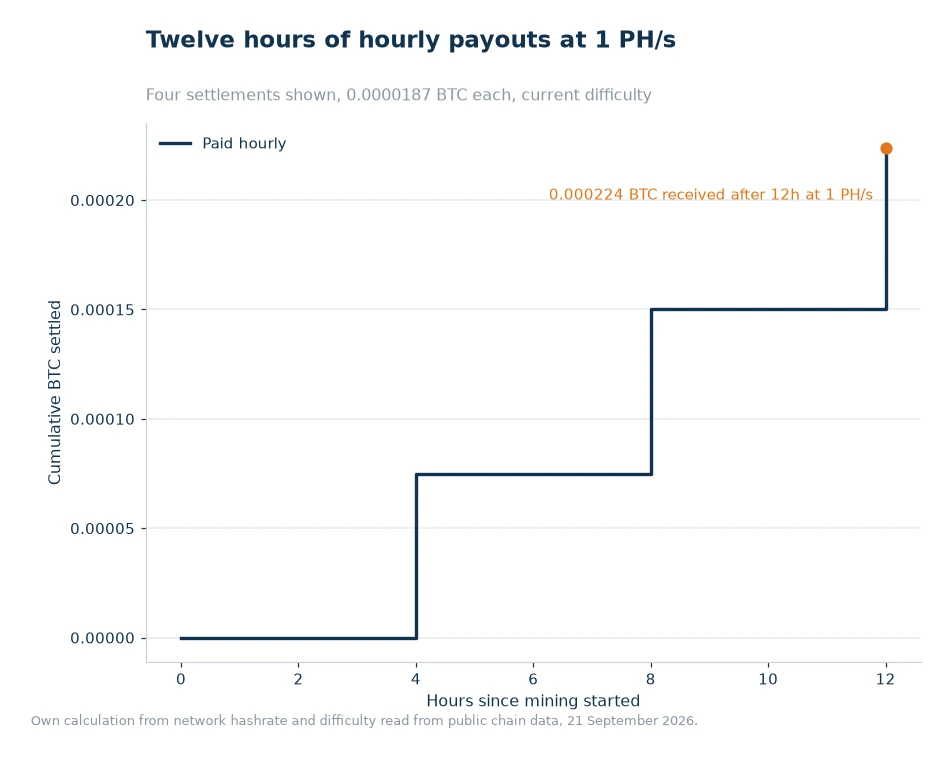
- At 1 PH/s, hourly PPS+ settlement credits about 0.0000187 BTC, so a 12-hour window accumulates 0.000224 BTC — about $19.00 at $84,692.
- A 100 TH/s machine earns $0.16 an hour; six hours of unnoticed downtime costs $0.95, which is roughly the price of a single mid-range alerting mistake.
- Both mobile builds support real-time hashrate monitoring, alerts and multi-account management — the pool-side feature set does not differ by platform.
- The variable is the device: background refresh limits, battery saver and notification permissions decide whether an alert is delivered in a minute or discovered a day later.
The core idea
A mining dashboard is a thin client over pool-side numbers. Your workers submit shares to the pool, the pool computes effective hashrate from those shares, and the app polls or receives that value. Nothing about your income depends on which operating system requests it, which is why two phones in the same room can show the same balance while behaving nothing alike.
What differs is everything around the number: how aggressively the OS suspends background network access, whether push notifications arrive silently in a summary, and how biometric unlock interacts with a session that the pool keeps alive between requests. Those are operational details, and they are the ones that turn a monitoring tool into either a watchdog or a decoration.
| Reading | Where it comes from | What it cannot tell you |
|---|---|---|
| Per-worker hashrate | Shares the pool received in the current window | Whether the cause of a drop is thermal, network or firmware |
| Effective hashrate | Accepted shares, excluding rejects and stales | Whether your firmware is weak or the site uplink is lossy |
| Settled balance | Payouts already credited under the chosen method | What is still accruing inside an open PPLNS window |
| Estimated daily earnings | Your hashrate at the current difficulty and price | Tomorrow's difficulty, which retargets every 2,016 blocks |
How it plays out at scale
On a single machine the difference between platforms is cosmetic. On a farm it becomes arithmetic. Suppose a 1 PH/s operation watches a total-hashrate tile that refreshes when the app is opened. The operator checks it twice a day, so the worst case is a fourteen-hour blind window, which at 1 PH/s is about $22.17 of gross output. A platform that delivers a push notification within a minute from the same pool data converts that into minutes.
Notification routing
Push delivery is a platform policy decision, not a pool decision. Where an OS batches or silences low-priority notifications, a hashrate alert can arrive without sound, vibration or badge — technically delivered and practically missed. Marking the mining client as a high-priority app, or using a distinct alert tone, is what makes the mechanism work in practice.
Background refresh
Battery optimisers suspend background networking for apps they consider idle, and a mining dashboard is the archetype of an idle app between alerts. On both platforms the fix is a permission rather than a feature: exempt the app from battery optimisation and allow background refresh, then verify by closing it and watching whether an alert still arrives.
Two scenarios compared
Both scenarios use the same rig and the same pool. The rig is 100 TH/s of 20 J/TH hardware: about 2 kW, 48 kWh a day, $2.88 of electricity at $0.06/kWh, against 0.0000449 BTC — $3.80 — of gross daily output at a $84,692 price.
Scenario 1: no alerting. A fan bearing fails at 01:00. The dashboard is checked at 08:00 and reports the machine at zero, so six hours of output are gone: about $0.95, or 25% of that day's gross, plus electricity already spent on cooling a machine that was not hashing.
Scenario 2: push alert with a 15% floor. The same failure triggers a notification at 01:04. The operator restarts the machine remotely at 01:20 — the good news is that most such faults are software or thermal rather than terminal — and loses about $0.05 of output. Same hardware, same pool, roughly a 20-fold difference in cost.
Both platforms need a reliable path to the same pool data, which is why operators tend to standardise on one client across the fleet. The ViaBTC App Download covers iOS and Android builds with real-time hashrate monitoring, alerts and multi-account management, so a site with mixed handsets keeps one definition of "normal" instead of two.
Common failure modes
- Notification permission granted but muted by focus modes — the alert exists and nobody hears it.
- Battery optimisation re-enabled after an OS update — background sync silently stops, and the dashboard shows a stale figure until it is opened.
- Reading cached tiles as live values — always confirm the refresh timestamp before drawing a conclusion from a low number.
- Watching farm totals instead of workers — one dead machine out of twelve moves the total by about 8%, which most thresholds tolerate.
- Checking one platform's numbers against another app's — the mobile mining dashboard and the firmware interface measure different things: shares received versus hashes attempted.
- Sharing one login across operators — if session controls are not managed per person, revoking access means changing the password for everyone.
None of this changes what a mining pool pays. It changes how quickly you learn that you are not being paid, which on a farm with a fixed power bill is the difference between a scheduled cost and an unplanned one.
Frequently asked questions
How often should a miner check pool statistics?
Weekly is enough for cash flow, daily if you are reconciling worker uptime or chasing a hashrate fault.
Does the payout method change my average income?
It changes the variance and the fee, not the underlying expected value: your share of network hashrate still sets the ceiling.
Do the two mobile platforms show the same mining data?
Yes. The pool-side figures are identical, and both builds support real-time hashrate monitoring, alerts and multi-account management. Differences come from device settings — notification priority, background refresh and battery optimisation — rather than from the reported data.
Why does the dashboard show less hashrate than my firmware?
Firmware reports nominal hashrate, while the dashboard reports effective hashrate derived from shares the pool accepted. Rejects, stale shares and the length of the measurement window all pull the pool-side number below the firmware figure.
Make the phone behave like a watchdog
Grant notification permission, exempt the client from battery optimisation, allow background refresh, and set a distinct alert tone. Then test it: turn one machine off for fifteen minutes and confirm the notification arrived while the phone was locked and idle. Repeat the test after every OS update, because platform policies change more often than difficulty does — and difficulty, at 132.76 T on 21 September 2026, is already moving faster than most operators check.
Data and sources: ViaBTC documentation on mobile monitoring and multi-account management[1], ViaBTC pool statistics page for pool and network hashrate[2], and the ViaBTC pricing page for hourly PPS+ settlement[3]. Network difficulty (132.76 T), network hashrate (about 1,003 EH/s) and the BTC price of $84,692 were read from public chain data and market feeds on 21 September 2026. Figures are illustrative and change with difficulty and price.