
What Really Drives Reuse Cycles on Formwork Boards
A formwork plywood panel is not bought for its first pour; it is bought for every pour after it. Dongstar Wood states that high-grade film faced panels can survive 10–20 concrete pours, and the gap between one cycle and twenty is decided by the film, the core, the edges and the handling on site.

Key takeaways
- The published ceiling is 10–20 reuses for high-grade panels in concrete pouring projects.
- Film weight differs by surface: 165 g/㎡ on the smooth film, 130 g/㎡ on the lighter option.
- Six core options — Birch, Eucalyptus, Acacia, White Hardwood, Rubber and Combi — set the panel's strength and weight.
- Thickness is driven by the load: 18 mm for heavy formwork, rising to 21 mm and above for bridges and high-load platforms.
What a reuse cycle actually costs
The arithmetic of formwork is arithmetic of area. A panel that survives twenty pours delivers twenty times the contact area of a single-use board, and the client's own example makes the point: one panel used 20 times serves 20 pours, while five panels serve 100. The purchase price is divided by the cycle count, so the number that matters is not the price per sheet but the price per pour. A board that costs more and lasts twice as long is the cheaper board on every project except the one that never pours twice.
Film weight and surface type
The phenolic film is the panel's first defence against concrete, and the mill publishes two weights: 165 g/㎡ on the smooth surface and 130 g/㎡ for the lighter variant. The surface range covers dark brown film, black film and anti-slip film, and the choice is a site decision as much as a price decision. Smooth film releases cleanly and leaves an even concrete finish; anti-slip film trades some of that release behaviour for grip underfoot on scaffolding boards and walkboards. What the film cannot do is survive careless handling — a film is a wearing surface, not a structural one, and a chipped edge lets water into the core long before the face wears through.
Core choice under repeated pours
Six cores are offered for the formwork range: Birch, Eucalyptus, Acacia, White Hardwood, Rubber and Combi. The client's own descriptions position Eucalyptus Core at the maximum-strength end with high compression resistance and bending performance, Acacia Core as a high-strength hardwood with excellent density and a long service life, and White Hardwood Core — species like Bodhi or mixed light hardwoods — as the stability-and-cost option. Combi Core blends species to balance strength, weight and cost. Under repeated pours the core is what keeps the panel flat: a core that delaminates at the edges ends the reuse count however good the film still looks.
The glue class that binds the core layers is the next factor in reuse. Phenolic Dynea and WBP adhesives are the classes designed for formwork because they resist the wetting and drying cycles that a pour-and-strike programme creates. A panel pressed with a standard MR adhesive may survive its first pour, but the bond line begins to break down as water enters through the edge and the face cycles between wet and dry. The published glue classes — E0, E1, E2, MR, WBP and Phenolic Dynea — are not interchangeable in formwork, and the right class is the one that holds the core together through the entire programme, not the one that costs the least on a purchase order.
Thickness and the load path
The thickness guidance is blunt: 18 mm for heavy formwork, and 21 mm and above for bridges and high-load platforms. The logic is the load path — a panel spanning between joists or supporting wet concrete and workers at the same time is a beam, not a cover, and the extra millimetres buy stiffness that a thinner panel cannot fake. Contractors who standardise on one thickness simplify their shuttering inventory; those who match thickness to the load path stop replacing panels mid-pour.
Sizes and the custom maximum
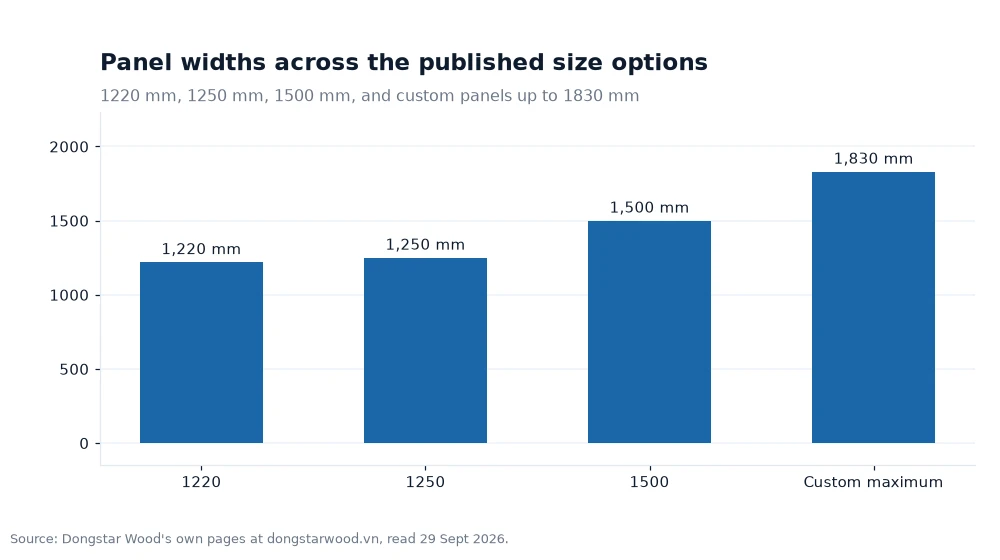
Three standard widths are published: 1250 × 2500 mm, 1220 × 2440 mm and 1500 × 3000 mm, with custom panels up to 1830 × 3830 mm available on request. Those dimensions decide how many panels a crew lays per pour and how many joints the concrete sees. Fewer, larger panels mean fewer seams and faster striking, which matters because the reuse count is earned pour after pour and lost to a slow setup every single time. A Film Faced Plywood order that matches the width to the formwork system is the difference between a panel that cycles and a panel that sits in the way.
| Factor | Published figure | Effect on reuse |
|---|---|---|
| Reuse ceiling | 10–20 times, high-grade panels | Sets the pours-per-sheet budget |
| Film weight | 165 g/㎡ smooth; 130 g/㎡ | Wearing surface and release behaviour |
| Cores | Birch, Eucalyptus, Acacia, White Hardwood, Rubber, Combi | Flatness and edge life under load |
| Thickness | 18 mm heavy formwork; 21 mm+ bridges | Stiffness across the span |
| Custom maximum | 1830 × 3830 mm | Fewer joints per pour |
Worked example: pours per sheet over a project
Example only, using the published figures. A single 1250 × 2500 mm sheet provides 3.125 m² of contact (1.25 m × 2.5 m). At the published ceiling of 20 reuses, one sheet delivers 20 × 3.125 = 62.5 m² of formwork contact area; at 10 reuses it delivers 10 × 3.125 = 31.25 m². A project needing 625 m² of contact area over its pours therefore consumes 625 ÷ 62.5 = 10 sheets at the ceiling, or 625 ÷ 3.125 = 20 sheets at the floor of the range — the reuse count, not the sheet price, sets the material budget.
The arithmetic also shows why edge care matters: a panel that loses one pour to careless handling drops from 20 to 19 reuses, which reduces its contact area from 62.5 to 59.375 m² — a loss of 3.125 m² of contact surface from a single event. Over a twenty-pour programme, that is the equivalent of losing one full pour of coverage, and the difference is entirely in how the crew treats the edges when the formwork is stripped and stacked.
Frequently asked questions
How many times can a formwork panel be reused?
Dongstar Wood publishes a reuse ceiling of 10–20 concrete pours for high-grade film faced plywood. What decides the count is the film, the core, the edge care and the handling the panel receives on site.
Which core lasts longest in formwork?
The client positions Eucalyptus Core at the maximum-strength end and Acacia Core as a high-strength hardwood with a long service life. Under repeated pours the core keeps the panel flat, so core choice matters as much as film weight.
What thickness should heavy formwork use?
The published guidance is 18 mm for heavy formwork; bridges and high-load platforms, where the panel acts as a beam across the span, take 21 mm and above.
From cycle count to site routine
The reuse ceiling is a published number; the reuse count is a site habit. Compare the ordinary black range when the budget is tight and the pour count is modest, and the anti-slip boards where grip underfoot matters as much as concrete release. Both ranges publish their film, core and thickness options, so the comparison a buyer makes is between published numbers, not between sales promises.
All quantities referenced were taken from Dongstar Wood's product listings accessed 29 Sept 2026[1].