
A kids-safe perfume line is only as compliant as its document file, and the file has six layers: the formula reference, the ingredient restriction review, stability and compatibility reports, closure evidence, the label check, and the shipment papers. Each layer is produced at a different moment in the project, and missing any one of them can stop a shipment that already passed quality control. Build the file forward, and compliance becomes a review instead of a rescue.
Key takeaways
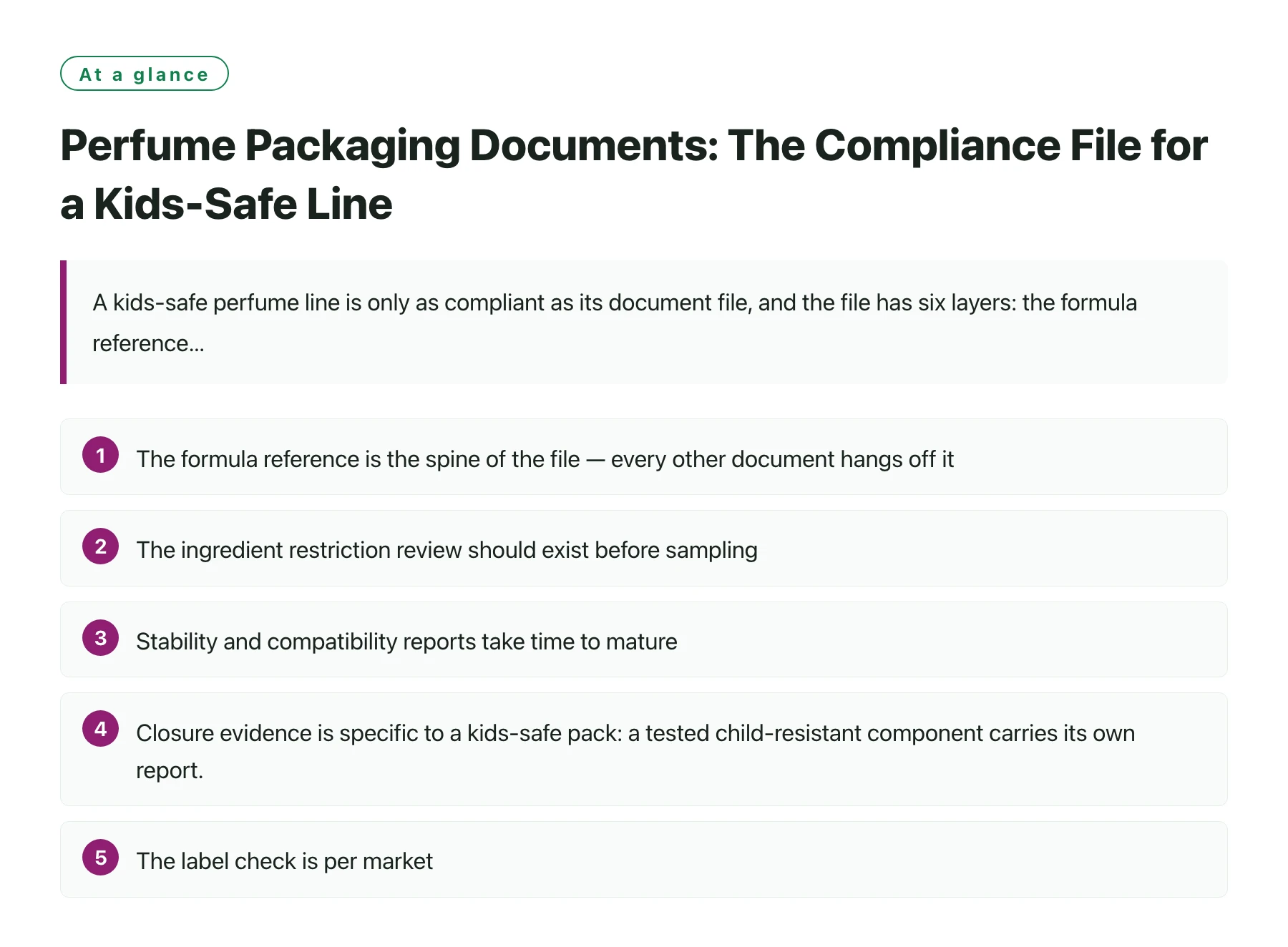
- The formula reference is the spine of the file — every other document hangs off it, and it must be named, dated and versioned.
- The ingredient restriction review should exist before sampling, because it defines the brief more than the fragrance family does.
- Stability and compatibility reports take time to mature, so their schedule drives the launch date more than production does.
- Closure evidence is specific to a kids-safe pack: a tested child-resistant component carries its own report.
- The label check is per market, and a single-market check is not a compliance strategy for a multi-market line.
Most of the anxiety around compliance is really anxiety about missing documents discovered late. The fix is boring and effective: list the documents, decide who produces each one, and schedule them into the project. This article is that list, written for a kids-safe line where the closure evidence and the ingredient review carry extra weight.
The six layers below run in project order. If a supplier offers to 'handle compliance' without naming these layers, that is the moment to ask for the list — the list is the promise.
The six layers of the compliance file
Each layer answers a question that someone will eventually ask: what is this product, what is in it, will it stay the same, is the pack safe, is the label true, and can it cross a border. Work through the layers in order and the file assembles itself.
Layer 1 — the formula reference
A dated, versioned reference for the finished formula is the spine of the file. Every stability report, label and batch record points back to it. If it is ambiguous, every layer above it is ambiguous too.
Layer 2 — the ingredient restriction review
The review lists the materials in the formula and their restriction status against the applicable frameworks. It should exist before sampling, because it is part of the brief: decide what you will not use before you fall in love with a scent. For a kids-safe line this layer defines the product more than the fragrance family does.
Layer 3 — stability and compatibility
These reports prove the product stays within its specification over time and that the formula, the closure and the glass work together. They are the slowest layer — the testing has a defined duration — which is why they are scheduled first, not last.
Layer 4 — closure and packaging evidence
For a kids-safe pack, the closure carries its own document: the test report behind a child-resistant fastening, referring to the standard it meets. Glass and decoration may carry similar evidence where drop behaviour or ink safety is specified.
Layer 5 — the label file
The label file shows the artwork checked against each target market's rules: ingredient listing, allergen naming, warnings and claims. One market's correct label is another's compliance failure, so the file is organised by market, not as a single artwork.
Layer 6 — shipment paperwork
The commercial layer: packing lists, certificates, declarations and the documents a specific importer needs. It is assembled per shipment, but its content depends entirely on how cleanly the first five layers were built.
Who produces each layer, and when
| Layer | Produced by | Needed by |
|---|---|---|
| Formula reference | Manufacturer, from the approved formula | Before sampling starts |
| Ingredient review | Manufacturer's development team | Before the first sample round |
| Stability and compatibility | Laboratory, in house or third party | Scheduled on first acceptable sample |
| Closure evidence | Closure supplier, verified by a lab | At the pack specification stage |
| Label file | Brand together with manufacturer | Before artwork goes to print |
| Shipment papers | Manufacturer and forwarder | At every shipment |
Notice that half the layers are due before production even begins. A file that is complete before the first bulk order is not bureaucracy — it is a launch that cannot be blocked by paper.
Market-by-market notes that change the file
The file takes its shape from the markets you ship to. Canada, for example, publishes its cosmetics safety and labelling requirements openly, and a product sold there has to meet them before it can lawfully be on sale [1]. That is a concrete, checkable requirement — not a rumour from a checklist — and it belongs in your per-market column.
For the EU, the Commission's cosmetics pages describe the specific topics a product file must cover and how products are notified before being placed on the market [2]. The EU file is the most structured example, and manufacturers that export there regularly keep the template so close that your project simply fills it in — which is exactly the level of readiness you want to see.
One more document layer that buyers forget: intellectual property. If the bottle shape or the pack design is an asset, the design should be registered, and WIPO runs the international registration route that lets one filing cover several countries [3]. A registration is a document you produce once, early, and it protects the pack that the whole compliance file describes.
Where does the manufacturer fit into all this? On the supplier side, the difference shows up in how the factory presents itself: a manufacturer that documents its background and certifications openly (its background and certifications) is running the same discipline internally that your file needs externally. You can check that transparency before you talk scope, and it predicts the rest.
If your route is a private label line, the file layers are identical — the difference is only who holds the originals. For private label production built through white label fragrance manufacturing (white label fragrance manufacturing), you typically inherit part of the evidence and must validate the rest for your variant; for a fully custom project the file is built in your name from scratch. Either way, the six layers are the contract.
And when you are comparing how seriously a potential partner treats compliance, the fastest signal is the site behind the products: the information a manufacturer publishes on the Xuelei's website (Xuelei's website) — what it lists about certifications, scope and process — is a preview of how itemised its document file will be. Transparency in public is usually transparency in project files.
The compliance file has exactly one rule: every layer is due before the next layer can be trusted. Build it in order, and a market review becomes a ten-minute check instead of a project of its own.
Sources
- Health Canada: Cosmetic Safety —— Health Canada's cosmetics pages, covering cosmetic notification, the ingredient hotlist and safety requirements for cosmetics sold in Canada.
- European Commission: Cosmetic Products — Specific Topics —— EU pages covering specific cosmetics topics such as product claims, nanomaterials and animal-testing rules.
- WIPO — World Intellectual Property Organization —— The UN agency for intellectual property; resources on industrial design and patent protection relevant to product and packaging design.
Frequently asked questions
Which compliance documents are mandatory for cosmetics?
That depends on the market. The common spine is a product file covering composition, safety assessment, manufacturing method, stability and labelling, plus market-specific notification steps. Name your target markets up front and map each one to its required layers — the list is shorter than it looks once it is written down.
Who should prepare the ingredient restriction review?
The manufacturer's development team, because they hold the formula and the material data. Your job is to require it in writing and read it for the restrictions you care about. A review that exists only after you ask twice is a review that would have been forgotten.
Do I really need separate label checks per market?
Yes, because ingredient and allergen naming rules differ, and a label built for one market will not automatically satisfy another. The label file should be organised by market, with the artwork checked against each market's rules before it is printed.
What happens if a document is missing at shipment?
The shipment stops, or the importer holds it until the document arrives — and documents like stability reports cannot be produced on demand because they take time. That is why the file's schedule, not the factory's, sets the realistic launch date.
Should I register the bottle design?
If the pack is part of your brand's identity, yes — an industrial design registration protects the shape, and the international route makes one filing cover multiple countries. Register early, before the design is public, because disclosure can affect the ability to register.